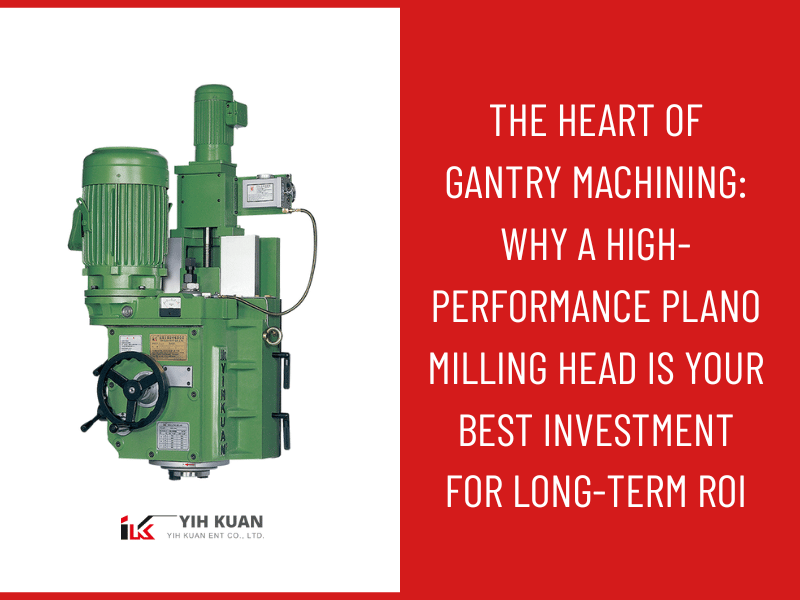
The Heart of Gantry Machining: Why a High-Performance Plano Milling Head is Your Best Investment for Long-Term ROI
In the rapidly evolving manufacturing sector of India—from the massive automotive hubs in Pune to the high-tech aerospace clusters in Bangalore—efficiency and cost-effectiveness are the keys to staying ahead.
When operating large-scale Gantry Milling Machines, many workshop owners focus on the machine's overall size. However, the real secret to precision and profitability lies in the Plano Milling Head. As the "heart" of your machine, the milling head dictates not only the quality of your output but also your long-term operational costs.
Why Durability and ROI (Return on Investment) Matter
In heavy-duty machining, the cheapest option often becomes the most expensive one due to unexpected downtime and frequent repairs. For an Indian factory owner, ROI isn't just a financial term; it's about machine uptime.
1. Engineered for Extreme Durability (Lower Maintenance Costs)
At Yih Kuan, we leverage over 20 years of specialized experience in Taiwan's precision engineering industry. Our heads are built with high-grade alloy steel, featuring:
Precision Gear Grinding: Reduces friction and heat, extending the life of internal components by up to 40% compared to standard heads.
Rigid Spindle Support: Designed to handle heavy-duty cutting torque without vibration, ensuring a longer tool life.
Lower Total Cost of Ownership: Experience fewer parts replacements and extended service intervals.
2. Precision that Eliminates Costly Rework (Higher Yield Rates)
In large-scale machining, such as wind energy components or engine blocks, a single error caused by thermal displacement can scrap a workpiece worth millions of Rupees. Yih Kuan's optimized lubrication and cooling paths minimize spindle growth, ensuring that your first cut is as precise as your last.
3. Versatility: Turning a 3-Axis Machine into a Profit Center
Multi-face Machining: Process the top and sides of a workpiece in a single setup.
Reduced Man-Hours: Save up to 50% of the time usually spent on re-clamping and re-aligning heavy workpieces.
Real-World ROI: A Quick Calculation By switching to a Yih Kuan Plano Head, a typical workshop can increase feed rates by 20%. This saves 4 hours on a 20-hour project. Over a year, this extra capacity allows for more projects and eliminates costly maintenance shutdowns, paying back your investment in record time.
Our ISO-certified manufacturing process and commitment to "Professionalism, Innovation, and Speed" ensure that every milling head leaving our facility in Taiwan is ready for the toughest industrial environments in India.
Upgrade Your Production Today
Don't let an underperforming milling head bottleneck your growth. Choose Yih Kuan for the perfect balance of Taiwanese precision and unbeatable durability.
Recently, a customer told us he had been considering replacing the angle head on his machine for quite some time. The challenge was that his existing equipment had its own structure and operating procedures. Even after finding a model with the right machining angle, one question remained: once the new head was installed, how would the operators use it?
As YIH KUAN looks back on 2026, this is one of the questions we want to explore. When assessing Taiwan’s machine tool industry, we naturally look at how many machines are exported each year. Yet following a Taiwan-made milling head into an overseas factory reveals a broader picture. Some Taiwanese manufacturers supply complete machines. Others contribute to the design of new machines overseas, while others work with local rebuilders to help equipment that has been in service for years take on new workpieces.
Beyond Export Figures: Who Buys Machine Tool Components?
According to the Taiwan Machine Tool & Accessory Builders’ Association (TMBA), Taiwan’s machine tool exports totaled US$1.659 billion from January to October 2026, down just 0.2% year over year and essentially unchanged. Over the same period, exports of key components reached US$1.423 billion, an increase of 14.5%.
These component figures cover multiple product categories. Looking specifically at milling heads, the field YIH KUAN knows best, understanding who is buying helps explain why machine and component exports may follow different trends.
When developing new machines, overseas machine tool builders can source milling heads from Taiwan and integrate them with their own machine beds, slides, and control systems. Meanwhile, a machine shop with a gantry milling machine whose bed and feed system remain in good condition may work through a local distributor or rebuilder to replace only the worn milling head.
One buyer is building a new machine; the other wants to keep using familiar equipment. Both can generate orders for Taiwanese components.
Opportunities in Special-Purpose Machines Begin with the Workpiece
Consider a valve body that requires machining on both its top and side surfaces. Suppose the current process involves milling the top, then lifting, turning, clamping, and realigning the workpiece before machining the side.
A special-purpose machine builder should first ask: how much time does each workpiece require for repositioning and alignment? If the cutting tool could approach from the side, could both operations be completed in a single setup?
The fixture manufacturer understands how to secure the workpiece. The machine builder knows the slide travel and overall machine layout. The milling head manufacturer must assess whether the cutter can clear the fixtures and whether the spindle is suitable for the intended cutting conditions.
By reviewing drawings together early in the design process, these partners may be able to eliminate the repeated task of turning each workpiece. This is an opportunity we see for Taiwanese component manufacturers: participating earlier in design and working with machine tool and special-purpose machine builders to determine how each operation can be performed more effectively.
Why Choose YIH KUAN? Start with How the Machine Is Used
Returning to the customer who wanted to replace his angle head, we begin such discussions by asking about everyday operation. Which orientations are used most often? How frequently is the head removed and reinstalled? How do operators currently position it when moving to the next machining surface?
The answers influence the flange design, the location of the positioning mechanism, and whether familiar operating procedures can be retained.
YIH KUAN has been manufacturing milling heads in Taiwan since 1977. We take the time to understand your workpieces, the limitations of your existing equipment, and how your operators work. From there, we work with you to identify the milling head or angle head solution best suited to your shop floor.
If a standard milling head already meets the cutting requirements, we can focus our efforts on the mounting interface that needs adapting. If the machine is still being designed, we are also happy to review workpiece drawings with the machine builder and discuss where the milling head should be installed.
Looking ahead to 2027, we hope to see Taiwan’s machine tool industry play a wider range of roles in factories around the world. For YIH KUAN, the most practical step is simple: when a customer brings us photos of an existing machine or drawings of a new workpiece, we sit down and listen to what they want that machine to accomplish in the coming year.
Is your turret milling machine experiencing unexpected vibration, spindle noise, declining machining accuracy, or irregular table movement? Which component is causing the problem? Should you replace the milling head or repair the entire machine?
Taichung is one of Taiwan's major machine tool and precision machining industry hubs. Many mold manufacturers, metalworking companies, and machining workshops rely on turret milling machines for daily production. However, machine problems can originate from cutting tools, machining parameters, milling heads, worktables, or other mechanical components. These issues do not necessarily mean the entire machine needs replacement.
YIH KUAN specializes in milling head manufacturing and applications. This guide explains six common turret milling machine problems and provides practical troubleshooting directions to help operators identify potential causes and determine when professional assistance may be required.
1. What Are the Six Most Common Turret Milling Machine Problems?
Over time, turret milling machines may develop operational problems due to component wear, changing machining conditions, or improper machine adjustments.
When an issue occurs, first record when it happens. Does it occur during idle spindle operation, cutting, speed changes, or table movement? These observations can help narrow down possible causes.
Identify when the issue occurs and inspect the milling head if necessary
Reduced machining accuracy
Cutting tools, spindle, worktable, guideways
Identify the source of error and inspect machine geometry
Weak cutting performance or unstable spindle speed
Cutting load, motor, belts, transmission system
Compare machining conditions and power transmission performance
Irregular worktable movement
Guideways, lead screws, feed mechanisms
Inspect the movement mechanism and lubrication
Electrical control problems
Switches, wiring, electrical control system
Stop the machine and arrange a professional inspection
These symptoms are not always independent. For example, excessive vibration may also reduce surface finish quality, while abnormal spindle noise may occur together with overheating.
Therefore, troubleshooting should consider the overall operating conditions rather than identifying a faulty component based on a single symptom.
2. What Should You Check When a Turret Milling Machine Vibrates During Cutting?
Excessive vibration is a common issue in turret milling operations. However, the milling head is not necessarily the source of the problem.
We recommend checking the following factors in sequence:
Inspect the cutting tool
Tool wear, damaged cutting edges, or excessive tool overhang can reduce cutting stability and cause chatter marks on the workpiece.
Review cutting parameters
Spindle speed, feed rate, and depth of cut all affect machining stability. When the workpiece material or tool changes, previously used cutting parameters may no longer be suitable.
Check workpiece clamping
Insufficient clamping force, loose fixtures, or excessive workpiece overhang may also cause vibration.
Inspect the spindle and machine structure
If the cutting tool, machining parameters, and workpiece clamping appear normal but vibration continues, further inspection may be needed. Check spindle runout, bearings, spindle quill clearance, and machine structural conditions.
If a machine previously operated smoothly but repeatedly produces chatter marks under the same machining conditions, mechanical wear or looseness should be considered.
Key Takeaway: Determine whether vibration originates from cutting conditions or mechanical components before deciding to replace the milling head.
3. Does Spindle Noise or Overheating Mean the Milling Head Is Faulty?
Not necessarily.
Unusual spindle noise or temperatures significantly higher than normal may be related to lubrication, belts, bearings, or internal transmission components.
When these symptoms occur, consider the following observations:
Does the noise occur even when the spindle is running without cutting?
Does the noise become more noticeable as spindle speed increases?
Is the noise accompanied by vibration or abnormal temperature increases?
Does the problem occur only under specific machining loads?
These observations can support troubleshooting, but they cannot independently confirm which component has failed.
If excessive noise, rapid overheating, or severe vibration occurs, stop the machine and arrange an inspection by qualified personnel.
YIH KUAN has previously explained milling head lubrication, belt inspection, and routine maintenance in a dedicated article. For additional details, please refer to the following guide.
4. When Machining Accuracy Declines, Should You Inspect the Milling Head or the Worktable First?
Inconsistent workpiece dimensions, increased tool marks, or unstable machining quality may be related to the spindle, worktable, or other mechanical components.
The first step is to determine when the accuracy problem occurs.
Situation 1: Problems Occur During Spindle Cutting
If the workpiece repeatedly shows chatter marks, unusual tool marks, or unstable cutting performance, begin by checking tool clamping and spindle conditions.
Excessive spindle runout, bearing wear, or abnormal spindle quill clearance may indicate that the milling head requires further inspection.
Situation 2: Problems Occur During Worktable Movement or Positioning
If the table experiences unusual resistance or backlash, or machining errors vary across different table positions, inspect the guideways, lead screws, feed mechanisms, and machine geometry.
Workpiece clamping and measurement methods may also affect machining results.
Therefore, reduced accuracy should not automatically be attributed to the milling head. The source of the error must be identified before determining which component needs inspection or adjustment.
Key Takeaway: Determine whether the accuracy issue is associated with spindle operation, worktable movement, or workpiece clamping before selecting a corrective approach.
5. What Causes Weak Cutting Performance or Unstable Spindle Speed?
If spindle speed drops during cutting or the machine no longer performs as effectively as before, possible causes include excessive cutting load, motor output problems, or inefficient power transmission.
If the issue occurs only when machining specific materials or performing heavy cutting operations, first review the cutting tool, depth of cut, and feed settings.
If unstable spindle speed also occurs under normal machining conditions, further inspection of the motor, belts, and milling head transmission system may be necessary.
When the existing milling head no longer meets machining requirements, repair or replacement with a suitable configuration may be considered.
However, turret milling heads vary in motor power, speed adjustment methods, and transmission design. Selecting a higher-horsepower model without identifying the problem is not recommended.
YIH KUAN has published a separate guide comparing the horsepower and model differences of larger turret milling heads.
6. How Should You Handle Worktable Movement or Electrical Control Problems?
Not all turret milling machine problems originate from the milling head. The worktable, feed mechanisms, and electrical control system also play important roles in normal operation.
Irregular Worktable Movement
If the worktable experiences sticking, increased resistance, or inconsistent positioning, possible inspection points include:
The condition of guideways and sliding surfaces.
Lead screws and related transmission components.
Lubrication system performance.
Abnormal clearance in the worktable and feed mechanisms.
These problems generally require inspection of the machine's movement mechanisms rather than immediate milling head replacement.
Electrical Control Problems
If the machine fails to start normally, the motor stops unexpectedly, switches malfunction, or other electrical issues occur, the cause may involve wiring or control components.
Until the cause is identified, the machine should be stopped and inspected by qualified personnel. Operators should avoid attempting repairs on energized electrical equipment.
Key Takeaway: Problems involving the worktable, feed mechanisms, or electrical systems should be handled by professionals with the appropriate technical expertise.
Although YIH KUAN specializes in milling heads, customers are also welcome to contact us about other turret milling machine problems. Depending on the requirements, we can help coordinate relevant supplier information and potential industry contacts.
7. Should You Repair the Machine, Replace the Milling Head, or Purchase a New Machine?
Not every problem requires a complete machine replacement. The appropriate solution depends on the location of the fault, the machine's overall condition, and the feasibility of repair.
In general, three options may be considered:
Option
Suitable Situation
Adjust or repair individual components
The problem is limited to specific components that remain economical and practical to repair
Replace the milling head
The main machine structure remains in good condition, but the milling head is worn or no longer meets machining requirements
Overhaul or replace the entire machine
Major components such as the worktable, guideways, or machine structure have significant problems
For machining companies in Taichung and other regions, an existing turret milling machine may still offer considerable value if its main structure and machining capability remain in good condition.
Instead of immediately purchasing a new machine, it is worth identifying the faulty components and evaluating whether repair or milling head replacement is practical.
YIH KUAN has experience evaluating milling head retrofits for turret milling machines from manufacturers such as Dah Lih and YCM. For more information about mounting requirements and retrofit considerations, see our existing article.
8. Can YIH KUAN Help with Turret Milling Machine Problems Beyond the Milling Head?
Yes.
YIH KUAN specializes in the development, manufacturing, and application of milling heads. Our product range includes turret milling heads, gantry milling heads, angle milling heads, and CNC milling heads.
Based on machining requirements, machine configurations, and mounting conditions, we can provide relevant recommendations for milling head selection and retrofit evaluation.
For milling head replacement, machine retrofits, or special mounting requirements, customers may provide photographs, dimensions, and technical drawings to support an initial evaluation.
Taichung is home to a well-established machine tool and mechanical component industry cluster. During everyday production, machining companies may encounter problems involving not only milling heads but also worktables, feed systems, electrical controls, and other machine components.
Milling heads are YIH KUAN's core expertise, but we understand that customers often need solutions for the entire machine.
Whether you operate a machining workshop in Taichung, elsewhere in Taiwan, or overseas, you are welcome to contact us even if your problem is not directly related to the milling head.
For example:
Worktable or feed mechanism problems.
Electrical control system issues.
Requirements for specific machine components or related equipment.
Uncertainty about which type of supplier or maintenance specialist to contact.
In addition to our milling head expertise, we can help gather information from other relevant suppliers and assist in identifying suitable business contacts or potential cooperation opportunities, based on the customer's requirements.
Our goal is to help customers clarify their needs more efficiently, reduce unnecessary inquiries between different suppliers, and identify suitable technical resources for their equipment.
9. What Information Should You Prepare Before Requesting Assistance?
If your turret milling machine is experiencing operational problems, preparing the following information can help us better understand your situation.
Recommended Information
Purpose
Machine brand and model
Identify the original machine and its configuration
Description of the problem
Understand vibration, noise, or other abnormal behavior
When the problem occurs
Distinguish between idle operation, cutting, speed changes, and table movement
Machine and component photographs
Help identify the machine and potentially affected components
Workpiece materials and machining conditions
Understand the actual machining requirements
Troubleshooting steps already attempted
Avoid repeating checks that have already been completed
If your inquiry involves milling head replacement or retrofitting, additional information such as the existing milling head model, mounting dimensions, spindle specifications, and motor details may also be useful.
You do not need to prepare every detail before making an inquiry. Even if you only have the machine model, photographs, or a brief description of the problem, you are welcome to contact YIH KUAN.
Conclusion: Identify the Problem Before Choosing the Right Solution
When a turret milling machine develops excessive vibration, spindle noise, accuracy problems, or irregular worktable movement, it does not necessarily mean the milling head has failed or the entire machine must be replaced.
The first step is to identify the possible source of the problem. Depending on the actual conditions, the solution may involve adjusting machining parameters, repairing components, replacing the milling head, or improving other parts of the machine.
YIH KUAN specializes in milling head manufacturing and applications, providing relevant recommendations for milling head selection, retrofitting, and related needs.
We can also assist customers with other turret milling machine inquiries by coordinating relevant supplier information and helping identify appropriate industry contacts.
Whether you operate a machining business in Taichung, elsewhere in Taiwan, or overseas, feel free to contact YIH KUAN regarding turret milling machine problems or milling head requirements.
Share your machine conditions and machining needs with us. We can help you explore suitable solutions and relevant technical resources.
This year, YIH KUAN will be presented at two partner booths during METALEX 2026.
Exhibition: METALEX 2026
Date: November 18–21, 2026
Venue: BITEC, Bangkok, Thailand
Meet YIH KUAN at: Booth AL01|PMC – Precision Machinery Research & Development Center Booth BS29|SAHAMIT MACHINERY PUBLIC CO., LTD.
METALEX is one of Southeast Asia's major exhibitions for metalworking, machine tools, manufacturing technologies, automation, and industrial solutions. It provides an important platform for manufacturers across Thailand and Southeast Asia to explore new technologies, equipment upgrades, machining solutions, and business partnerships.
In addition to supplying machine tool builders, YIH KUAN also supports machine retrofit companies and special-purpose machine manufacturers with milling head selection, machine upgrade solutions, flange and interface design, and machining application evaluation.
As Thailand continues to develop its automotive parts, mold and die, metalworking, and industrial manufacturing sectors, YIH KUAN looks forward to connecting with more local manufacturers at METALEX 2026.
Whether you are planning to improve an existing machine, develop a new machine, or solve a special machining application, our team can recommend suitable milling head solutions based on machine type, workpiece material, spindle speed, cutter size, and mounting interface.
We warmly welcome you to visit us and discuss your milling head, machine retrofit, new machine, and special machining requirements.
Venue: Kinh Bac Cultural Center, Bac Ninh, Vietnam
Booth: 691
Northern Vietnam has become an important manufacturing hub for electronics, automotive parts, metalworking, machinery, and industrial supply chains, with Bac Ninh playing a key role in the region’s continued industrial development.
VIMF Bac Ninh focuses on industrial manufacturing, automation, metalworking, machinery, and smart manufacturing solutions, providing an important platform for manufacturers to explore new equipment, improve production efficiency, and build new business partnerships.
In addition to supplying machine tool builders and special-purpose machine manufacturers, YIH KUAN also supports existing machine upgrades through milling head replacement, machine retrofit solutions, flange and interface design, and machining application evaluation.
For manufacturers looking to extend machine service life, improve machining capability, or develop new machines and special-purpose applications, YIH KUAN can recommend suitable milling head solutions based on machine type, workpiece material, spindle speed, cutter size, and mounting interface.
We warmly welcome you to visit our booth and discuss your machine upgrade, milling head selection, and machining application requirements with us.
From every hand tool used on the shop floor to every machining and inspection process, we work together to help manufacturers stay in control of every critical detail.
In manufacturing, no tool plays a minor role.
A reliable hand tool affects operational efficiency, safety, and consistency. A stable milling head determines machining performance and precision. Accurate measuring and inspection equipment helps manufacturers monitor production data, machine conditions, and quality details throughout the process.
From assembly, adjustment, and maintenance to machining and inspection, every tool and every process contributes to achieving high-quality manufacturing.
At 2026 Taiwan International Tools & Hardware Expo × International Hardware Expo Taiwan (TiTE × IHT), DAIKEN TOOLS will showcase its professional pliers and hand tools together with YIH KUAN ENTERPRISE, presenting a complete manufacturing perspective covering:
Professional Hand Tools × Machine Tool Components × Production Inspection
Since 1968, DAIKEN TOOLS has specialized in the development and manufacturing of professional pliers and hand tools.
Its product range includes VDE insulated pliers, high-leverage pliers, automotive service pliers, precision electronic pliers, special-purpose pliers, and cable cutters, along with OEM and ODM services.
With products supplied to more than 50 countries worldwide, DAIKEN TOOLS responds to the practical needs of different industries through professional design, rigorous inspection, and reliable durability.
Since 1977, YIH KUAN has been dedicated to the machine tool industry, specializing in professional milling heads and measuring and inspection equipment.
Our milling head solutions include turret milling heads, gantry milling heads, CNC gear heads, and angle heads. We also provide solutions for new machine integration, existing machine upgrades, and customized applications.
Through measuring and inspection equipment, we further help manufacturers monitor machine conditions, production data, and quality details—ensuring that machining performance is not only stable, but also accurately verified.
One company focuses on professional tools in the hands of skilled operators. The other focuses on the core of machine tools and extends its expertise into production inspection.
Coming from different fields of expertise, we share the same goal: improving every stage of the manufacturing process.
“From professional hand tools to machine tool components and precision inspection, we help manufacturers take control of every detail and achieve greater precision in production.”
We sincerely invite you to visit us at Booth E102 and discover the strength of Taiwanese manufacturing in professional hand tools, milling heads, machine upgrades, and production inspection solutions.
When selecting a vertical turret milling head, buyers often look first at motor power, spindle speed, and price. However, in actual machining environments, whether a milling head is durable, can maintain accuracy over time, and requires frequent maintenance often depends on details hidden inside the head.
Two milling heads may look very similar from the outside, but their internal construction can make a significant difference in long-term stability and performance. Below are four internal design details that help explain what makes a high-quality milling head.
4 Internal Details That Affect Milling Head Durability
1. Precision-Ground Internal Surfaces: A Stable Foundation for Assembly
Why does it matter?
If the internal mounting surfaces of a milling head are not machined accurately, bearings and spindle components may not sit perfectly in alignment after assembly. Even a small amount of misalignment can contribute to vibration, noise, and accuracy issues during long-term operation.
Practical advantage:
Precision-ground internal surfaces help components fit together correctly during assembly. Proper alignment can reduce abnormal vibration and operating noise while helping the milling head maintain machining accuracy over a longer service period.
2. SCM4 Chrome-Molybdenum Alloy Steel Spindle: Strength and Wear Resistance
Why does it matter?
The spindle rotates continuously at high speed while also carrying cutting loads. If the spindle material, heat treatment, or machining quality is insufficient, long-term use may result in increased runout, wear, or deformation.
Practical advantage:
SCM4 chrome-molybdenum alloy steel provides a combination of strength, toughness, and wear resistance. Together with controlled heat treatment and precision grinding, it helps the spindle maintain rigidity and stability under repeated machining loads.
Gears inside a milling head operate under continuous contact and friction. If the material pairing is inappropriate, long-term operation can result in accelerated wear or, in severe cases, gear seizure.
Practical advantage:
Critical bronze gears made from high-grade phosphor bronze offer good wear characteristics and work effectively with steel mating components. With proper lubrication and regular maintenance, gear wear can be reduced and the service life of the milling head can be extended.
4. Spiral Bevel Gears: Smoother Engagement and Lower Operating Noise
Why does it matter?
Gear tooth geometry affects how power is transferred between components. When gear engagement produces greater impact between teeth, vibration and operating noise can become more noticeable.
Practical advantage:
Spiral bevel gears use curved, angled teeth that enter engagement progressively rather than making contact all at once. This allows power to be transmitted more smoothly and can help reduce gear impact, vibration, and operating noise.
Buyer’s Tip: Ask These 4 Questions Before Choosing a Milling Head
When comparing milling heads or requesting quotations, asking a few additional technical questions can help you evaluate what is inside the product instead of comparing specifications alone.
Are the internal bearing mounting surfaces precision ground?
What material is used for the spindle, and what are the hardness and spindle runout inspection standards?
What alloy is used for the internal bronze gears?
Are replacement parts and maintenance support available after purchase?
Common Questions About Milling Head Durability
Q: Is a harder spindle material always better?
Answer: Not necessarily. Excessive hardness can also increase brittleness. In addition to the material itself, heat treatment, bearing preload, assembly quality, and spindle runout control all play important roles in maintaining machining accuracy.
Q: Does a phosphor bronze gear never wear out?
Answer: No. All mechanical transmission components experience some degree of wear. However, phosphor bronze provides good wear resistance, and proper lubrication can significantly help reduce wear and extend gear service life.
Q: If a milling head becomes noisy, does that mean the gears are damaged?
Answer: Not necessarily. Insufficient lubrication, worn bearings, loose fasteners, or other mechanical conditions may also cause abnormal noise. A complete inspection should be carried out before determining whether the gears need to be replaced.
Conclusion
When selecting a vertical turret milling head, specifications and external appearance tell only part of the story. Internal machining accuracy, spindle material, gear materials, and transmission design can all influence long-term stability, service life, and machining accuracy.
YIH KUAN specializes in the development and manufacturing of milling heads and offers a wide range of Vertical Turret Milling Headsfor different machine configurations and machining requirements.
Looking for the Right Vertical Turret Milling Head?
If you are looking for a new milling head or evaluating a milling head replacement, repair, upgrade, or specification change, you can provide your machine photos, mounting dimensions, spindle specifications, and machining requirements to the YIH KUAN team.
Based on the actual machine configuration and machining conditions, YIH KUAN can help evaluate a suitable milling head solution.


 TMTS Virtual Application