All greatness begins with a single, often quiet, choice. For Ingenious Machinery, our story begins with just such a moment—a moment defined by the courage to choose.
Chapter 1: The Courage to Choose Iron
Turn the clock back to the spring of 2004. It was an era when the semiconductor industry was taking flight, and the world’s spotlight was firmly fixed on the “silicon wafer.” Our founder, Dr. Pu, stood at a crossroads. One path led to the glittering high-tech electronics industry; the other led to the world of machinery—a world of oil stains, iron filings, and noise.
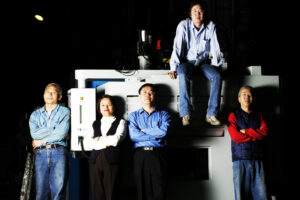
To many, the choice would have been obvious. But not to him. Fueled by a passion that some might have called stubborn, and backed by a group of middle-aged dreamers who believed “Taiwan can build world-class machines,” he chose the latter. He chose iron.
Thus,Yida Precision Machinery, YDPM was born. In a humble factory in Nantou, we had no grand background, only our technology and our dreams. We adopted the Phoenix as our totem—a symbol of rebirth and persistence. In those early, difficult days, we learned to embody the spirit of the Phoenix: to fall, brush off the dust, and rise again. It was during those countless nights of hard work that our foundational values of Humanity, Innovation, and Technology were forged deep into our DNA.

Chapter 2: Evolving Like Water
Ten years passed, and YDPM was no longer just a small local factory. Our footprint had crossed oceans, expanding from Taichung to Chicago, Hanover, Turkey, Mexico and many major industrial cities around the world.
Facing a volatile international market, we realized that “resilience” alone was no longer enough. In 2014, marking our 10th anniversary, we underwent our first transformation. We learned to become more like “water”—embracing Agility. We redesigned our brand identity to flow effortlessly, symbolizing that we were no longer just rigid manufacturers, but flexible partners capable of adapting to customer needs and the currents of the times.
With this agility and sincerity, we found our footing on the world stage. But the story didn’t end there. The real challenge was just beginning.

Chapter 3: The Truth in the Mirror
In 2023, we made a bold decision. We initiated the a brand transition project—not for marketing, but as a journey of soul-searching.
We embarked on a quest for honesty. Through 11 external interviews and 6 internal interviews, we faced the unfiltered voices of our clients and employees. The data and feedback revealed a stark truth: We saw our own power , but we also saw a gap. Clients trusted our technical depth and praised our speed, yet our external perception remained “traditional” and “conservative.”
We realized that the old coat we had worn for 20 years—YDPM—could no longer contain the robust and intelligent soul we had cultivated. What we needed was not a cosmetic makeover, but a rebirth.
Chapter 4: The Birth of Ingenious
Thus, Ingenious Machinery was born.
“Ingenious” is our new definition of self. It signifies that we are not merely building machines; we are employing Smart Ways to solve the most difficult problems for our customers.

This wisdom is intentionally etched into our new name and identity:
The Lowercase ‘i’: A reminder that no matter how high we soar, we must maintain Humility. We are always willing to listen to our customers’ voices.
The 15-Degree Tilt: A symbol of Speed and momentum. It represents our readiness to sprint forward. In this rapidly changing era, we are always one step ahead.
We have sublimated the spirit of the Phoenix, redefining our three core values: From simple technology, we evolved into Intelligence—thinking with data and foresight. From our original humanity, we deepened into customer-centric Integrity—honoring every promise. From past innovation, we refined into problem-solving Ingenuity—putting heart into every detail.
Shaping Future Inventions
Today, twenty years later, the young man who once chose “iron” has led the company down a path uniquely its own. We are no longer just manufacturers; we are partners dedicated to creating value together with our clients.
This is the story of YIDA. From the resilience of the Phoenix to the wisdom of Ingenuity. We are ready to join you in Shaping Future Inventions.

 TMTS Virtual Application