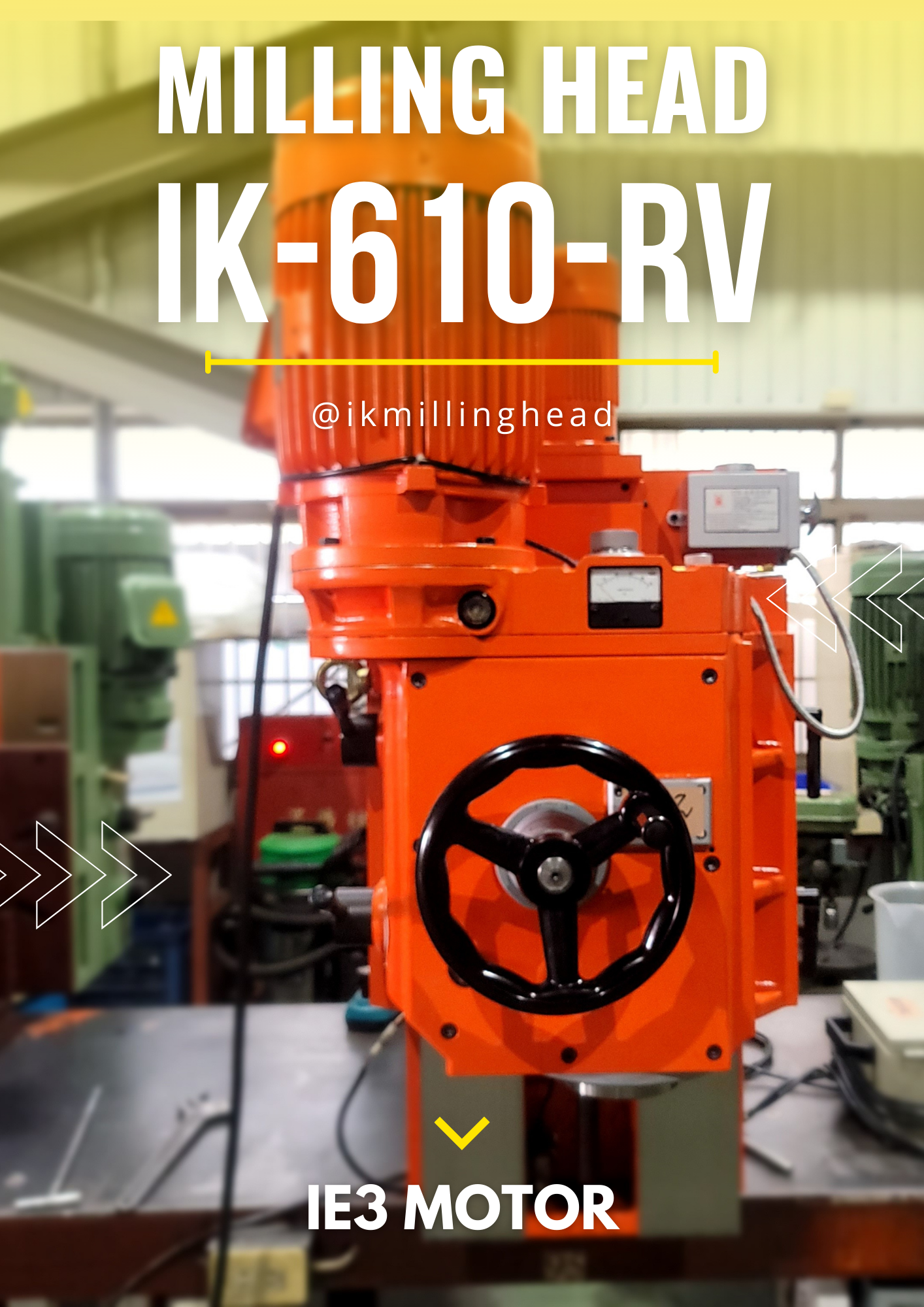
When YIH KUAN introduces its manual and semi-automatic milling heads to customers, one question often comes up:
“In an era of CNC machining and smart manufacturing, why are manual milling machines still needed?”
With the continued development of CNC control, automated production lines, and intelligent manufacturing technologies, many people tend to view manual milling machines as less efficient, outdated, or even close to becoming obsolete.
However, once you step into a mold shop, maintenance department, prototype center, vocational school, or a factory handling high-mix, low-volume production, you will find that manual and semi-automatic milling machines are still widely used.
The reason is simple: CNC milling machines and manual milling machines are not necessarily replacements for one another. They are designed for different types of machining work.
CNC milling machines are highly effective at performing stable and repeatable operations based on programmed instructions. Manual and semi-automatic milling machines, on the other hand, offer fast response, on-site adjustment, and greater operational flexibility.
The level of automation is important, but the more important question is:
Is the machine suitable for the actual machining task?
CNC and Manual Milling Machines Serve Different Purposes
CNC milling machines provide high accuracy, repeatability, and automated machining capability. They are especially suitable for:
- Mass production
- Highly repetitive machining
- Complex curved surfaces
- Standardized manufacturing processes
- Long machining cycles requiring consistent results
When production quantities are high, toolpaths are complex, or the same process must be repeated continuously, CNC equipment can significantly improve productivity and machining consistency.
However, not every machining task involves high-volume, repetitive, or highly standardized production.
For the following requirements, manual and semi-automatic milling machines may actually be more efficient:
- Single-part and small-batch production
- Maintenance parts and urgent repairs
- Local mold modification
- Prototyping and trial production
- On-site fitting and adjustment
- Special-angle or non-standard machining
Therefore, companies should not evaluate equipment based only on its level of automation. Production quantity, workpiece complexity, setup time, delivery schedule, and on-site adjustment requirements should all be considered.
CNC Milling vs. Manual and Semi-Automatic Milling
The following comparison provides a quick overview of the different positioning of each machine type:
| Evaluation Factor | CNC Milling Machine / Automated Production Line | Manual / Semi-Automatic Milling Machine |
|---|
| Best suited for | High-volume production, repetitive parts, complex surfaces | Single-part prototyping, mold repair, equipment maintenance |
| Setup time | Longer; usually requires programming, tool setting, and simulation | Shorter; machining can begin quickly based on drawings and actual conditions |
| Equipment and maintenance cost | Higher, including controls, software, and electrical systems | Low to moderate, with a relatively simple mechanical structure |
| Flexibility for temporary changes | Usually requires program modification or process resetting | The operator can adjust immediately according to actual conditions |
| Operating characteristics | Executes programmed paths and preset parameters | The operator directly controls feed and cutting conditions |
This comparison is not intended to determine which machine is better. It simply shows that the two types of equipment are suitable for different tasks.
For large quantities of repetitive precision parts, CNC is usually the more reasonable choice. However, for a single maintenance component that must be modified immediately, creating a program, setting coordinates, and arranging a complete machining process may not be more efficient than using a manual milling machine.
Five Key Applications of Manual Milling Machines
1. Single-Part and Small-Batch Machining
In prototype development, small-batch production, and customized machining, quantities are often low and part specifications may vary significantly.
When CNC equipment is used for this type of work, the following preparation steps are usually required:
- Drawing review
- Program creation
- Toolpath planning
- Tool selection
- Work coordinate setup
- Tool setting and trial cutting
These steps are necessary for mass production because the setup time can be distributed across a large number of parts.
However, when only one or a few simple parts are required, the preparation time may be close to—or even longer than—the actual cutting time.
A manual milling machine does not require a complete machining program. The operator can select the spindle speed, cutting tool, and feed method directly according to the drawing, dimensions, and actual workpiece condition.
It is therefore particularly suitable for:
- New-product prototypes
- Experimental components
- Temporary replacement parts
- Simple customized parts
- Low-volume jigs and fixtures
- High-mix, low-volume production
In these situations, the ability to begin machining quickly may be more important than a high level of automation.
2. Local Mold Repair and Modification
During mold manufacturing, trial runs, and long-term use, molds may require local modification due to dimensional corrections, surface wear, impact damage, or product design changes.
Typical operations include:
- Mold-edge trimming
- Local groove machining
- Mating-surface correction
- Hole-position adjustment
- Local material removal
- Finishing after localized annealing
These tasks usually do not involve manufacturing a completely new mold. Instead, they require small, precise, and often temporary modifications to a specific area.
One major advantage of a manual milling machine is that the operator can directly feel changes during machining. This is commonly referred to as cutting-force and vibration feedback.
During local mold repair or finishing after annealing, an experienced machinist can evaluate machining conditions through:
- Cutting sound
- Resistance felt through the handwheel
- Tool-contact behavior
- Machine vibration
- Chip formation
Based on these signals, the operator can immediately adjust the depth of cut and feed rate.
For example, when the tool reaches a locally hardened area, the operator can instantly reduce the feed rate or cutting depth. This helps prevent sudden overload, tool chipping, surface damage, or excessive vibration.
CNC machines normally execute machining according to preset cutting parameters and G-code. Unless the machine is equipped with adaptive control, spindle-load monitoring, or real-time process feedback, an experienced operator may respond more quickly to local material variations through direct manual intervention.
This is one of the key reasons manual milling machines continue to provide value in mold repair and modification.
3. Equipment Maintenance and Fitting Operations
After years of operation, industrial equipment may experience worn, deformed, or damaged components. In some cases, the original replacement parts may no longer be available.
Common parts requiring machining during maintenance include:
- Brackets
- Flanges
- Keyways
- Spacer blocks
- Sliding blocks
- Connecting plates
- Mounting holes
- Locating and mating surfaces
These parts are often produced in very small quantities, with irregular specifications. Sometimes, no complete drawing is available, and the part must be machined according to an existing component or on-site measurements.
The main objective of maintenance work is usually not mass production. It is to restore the equipment to operation as quickly as possible.
Manual milling machines allow maintenance personnel to perform surface correction, slot milling, hole enlargement, edge trimming, or fitting operations directly according to actual site measurements.
A complete automated machining process does not need to be created for a single component.
For many machinery manufacturers, repair shops, and maintenance departments, a manual milling machine may not be the main production machine, but it remains an essential support machine for urgent repair work.
4. Vocational Education and Machining Training
Manual milling machines continue to play an important role in vocational schools, universities, and in-house technical training.
Through manual operation, students and trainees can directly understand:
- The relationship between spindle speed and cutting performance
- How feed rate affects surface finish
- How cutting depth changes spindle load
- The importance of workholding and machining references
- Tool selection and proper tool use
- Machining vibration, abnormal sound, and tool wear
- Dimensional inspection and error correction
When beginners rely only on CNC programs and machine interfaces, they may learn how to start the machine and execute a program without fully understanding what happens when the cutting tool contacts the workpiece.
Manual milling allows the operator to observe, hear, and feel the machining process directly. This helps build the judgment needed to recognize different cutting conditions.
These fundamentals remain valuable even after the operator progresses to CNC machining.
When abnormal noise, vibration, tool wear, or poor surface quality occurs, technicians still need to evaluate the issue based on machining principles and actual shop-floor conditions.
5. Special-Angle and High-Flexibility Machining
Some workpieces have unusual machining positions, angles, or structural features, such as:
- Inclined surfaces
- Side surfaces
- Deep or recessed machining areas
- Irregular profiles
- Difficult-to-reach local areas
- Surfaces requiring machining from multiple directions
When a machine with a fixed standard spindle is used, special fixtures may be required. The workpiece may need to be reclamped or repositioned several times.
When a manual or semi-automatic milling machine is equipped with a suitable milling head, such as:
the spindle angle can be adjusted according to the workpiece orientation and machining position.
This significantly increases machining freedom.
For certain non-standard machining tasks, the operator can quickly adjust the milling-head angle and feed direction according to the available space, tool-access direction, and workholding conditions.
This can reduce workpiece movement and repeated clamping.
Such high-flexibility machining is an important advantage of manual and semi-automatic equipment.
The Real Difference Lies in the Machining Task
Manual milling machines and CNC milling machines each offer different advantages.
CNC milling machines are suitable for high-volume production, repetitive work, and complex toolpaths. Manual and semi-automatic milling machines are more suitable for low-volume, high-mix, repair, modification, and rapidly changing on-site requirements.
Using a manual milling machine for long-term mass production may not be efficient.
Likewise, spending significant time on programming and setup for a simple repair part may not be the best use of resources.
A more effective equipment strategy is not to allow one type of machine to replace all others. Instead, companies should establish a clear division of labor:
- CNC machines handle high-volume and standardized production
- Manual and semi-automatic machines handle prototyping, maintenance, and flexible machining
- Special milling heads expand machining angles and working ranges
- Operators select the most efficient machining method according to the actual workpiece conditions
Conclusion: Let Each Machine Perform the Work It Does Best
In the age of smart manufacturing and increasing automation, manual milling machines have not lost their value.
For single-part and small-batch production, local mold repair, equipment maintenance, technical training, and special-angle machining, manual and semi-automatic milling machines still provide important advantages:
- Fast setup
- High flexibility
- Immediate adjustment
- Reasonable operating cost
They are not intended to replace CNC machines, and they should not necessarily be completely replaced by CNC equipment.
Not every machining job requires CNC. Truly efficient manufacturing means assigning each task to the most suitable machine.
If you are evaluating a manual or semi-automatic milling machine, or require a solution for special-angle machining, please provide your workpiece material, dimensions, and application conditions.
YIH KUAN can evaluate your machining requirements and recommend a suitable milling-head configuration.


 TMTS Virtual Application